
Establishing a forum dedicated to carbon farming Research and Innovation (R&I) within the CARBONICA platform represents a significant initiative to foster collaboration, knowledge sharing, and community building across various regions and expertise.
This forum is envisioned as an online space that gathers experts from all three Widening Countries (Cyprus, Greece, and North Macedonia) to pool their knowledge, experiences, and insights regarding carbon farming. It transcends geographical boundaries, encouraging participation from local experts and diaspora communities, fostering a diverse and global perspective on the subject.
At its core, this space is inclusive and inviting, welcoming project partners, stakeholders (such as farmers, researchers, policymakers, and environmentalists), and individuals enthusiastic about contributing to climate-resilient agriculture and carbon farming innovations.
Online Roundtable #8: Innovative tools and remote sensing for optimising carbon farming practices

Quote from eratosthenes-1 on March 1, 2026, 11:04 pmTitle:“Innovative tools and remote sensing for optimising carbon farming practices”
Date: January 30, 2026
Lead Working Group: North Macedonia
Moderator: Jovana Milosavljeva, AgFutura Technologies, North Macedonia
Working Group speakers:
- Thanos Arampatzis, Reframe Food, Greece (CARBONICA’s Project Coordination team)
Invited Diaspora expert speaker:
- Jovan Andevski ,Conservation Director, Vulture Conservation Foundation, Spain (NGO / Civil Society)
MAP Representatives invited speakers:
- Hakan Djuma, Associate Research Scientist, EEWRC, The Cyprus Institute, Cyprus (Academia)
- Georgia Kalousi, Senior Project Manager, Terra Spacium SA, Greece (Industry)
- Jozhe Jovanovski, Ministry of Transport and Communications, North Macedonia (Policy)
Key outcomes
- Land abandonment alone does not guarantee increased carbon storage
Evidence from abandoned terraces in the Troodos Mountains showed that while soil organic carbon concentrations (SOC) may increase, overall carbon stocks often remain unchanged due to soil erosion. This demonstrates the limits of abandonment as a carbon sequestration strategy and highlights the need for active agricultural management and erosion control to sustain soil carbon stocks.- Soil carbon sequestration is a long-term process requiring sustained monitoring
The findings confirmed that meaningful changes in soil carbon stocks occur over decades, underlining the need for long-term monitoring frameworks supported by digital tools and remote sensing, as well as realistic expectations within carbon farming and certification schemes.- SMEs play a pivotal role in translating carbon farming innovation into market-ready solutions
From an industry perspective, SMEs were highlighted as key actors bridging research and practice in carbon farming, enabling faster deployment of tools and services for monitoring, reporting, and verification.- Clear value propositions and tool readiness are essential for market adoption
The need for well-defined value propositions, robust assessment of technological readiness, and alignment of intellectual property strategies with commercialization pathways was emphasized as critical for scaling carbon farming solutions beyond pilot stages.- Data interoperability, trust, and regulatory clarity remain major barriers
Challenges are fragmented data systems, limited trust in carbon measurements, and regulatory uncertainty that constrain SME engagement, highlighting the need for stronger SME–research partnerships and investment in digital and Earth observation infrastructure.- Wildlife poisoning undermines biodiversity and the sustainability of carbon farming systems
Illegal use of pesticides and veterinary drugs was identified as a major threat to wildlife and ecosystem health, directly affecting the resilience and long-term effectiveness of biodiversity-friendly carbon farming practices.- Reducing pesticide use is critical for nature-positive carbon farming
The adoption of digital tools such as meteorological stations and pest and disease models can support precision agriculture, reduce chemical inputs, and align carbon farming with biodiversity protection goals.- Carbon farming can significantly support North Macedonia’s climate targets
The Agriculture, Forestry and Other Land Use AFOLU sector was highlighted as a key contributor to national climate objectives, with strong potential for carbon sequestration through afforestation, improved forest management, and soil carbon enhancement.- Policy frameworks are emerging but require effective implementation mechanisms
Draft laws and sectoral measures provide an enabling policy basis for carbon farming; however, their success depends on robust monitoring, reporting, and verification systems, as well as institutional coordination.- Financial support, capacity building, and inclusivity are critical enablers
Effective deployment of carbon farming practices requires targeted financial instruments, technical capacity building, and the integration of gender and climate considerations to ensure inclusive and resilient outcomes.📎 A one-page summary of the roundtable outcomes is available in the attached PDF.
💬 We invite forum members to share their views by responding to the pinned poll above. Your input helps enrich the discussion and reflect diverse perspectives from across the carbon farming community.
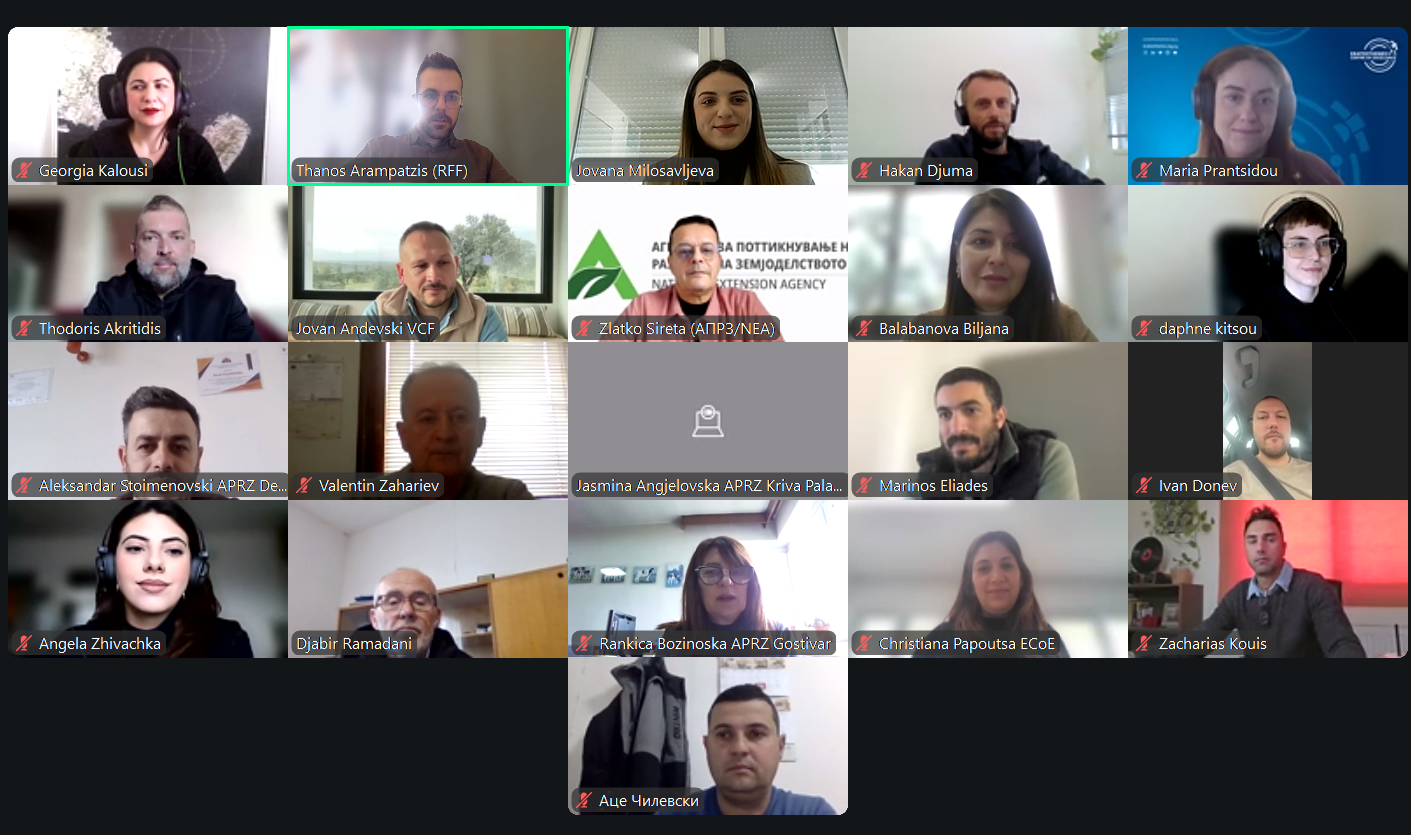
📸 Participants and speakers during the CARBONICA Roundtable #8:
Title:“Innovative tools and remote sensing for optimising carbon farming practices”
Date: January 30, 2026
Lead Working Group: North Macedonia
Moderator: Jovana Milosavljeva, AgFutura Technologies, North Macedonia
Working Group speakers:
- Thanos Arampatzis, Reframe Food, Greece (CARBONICA’s Project Coordination team)
Invited Diaspora expert speaker:
- Jovan Andevski ,Conservation Director, Vulture Conservation Foundation, Spain (NGO / Civil Society)
MAP Representatives invited speakers:
- Hakan Djuma, Associate Research Scientist, EEWRC, The Cyprus Institute, Cyprus (Academia)
- Georgia Kalousi, Senior Project Manager, Terra Spacium SA, Greece (Industry)
- Jozhe Jovanovski, Ministry of Transport and Communications, North Macedonia (Policy)
Key outcomes
- Land abandonment alone does not guarantee increased carbon storage
Evidence from abandoned terraces in the Troodos Mountains showed that while soil organic carbon concentrations (SOC) may increase, overall carbon stocks often remain unchanged due to soil erosion. This demonstrates the limits of abandonment as a carbon sequestration strategy and highlights the need for active agricultural management and erosion control to sustain soil carbon stocks. - Soil carbon sequestration is a long-term process requiring sustained monitoring
The findings confirmed that meaningful changes in soil carbon stocks occur over decades, underlining the need for long-term monitoring frameworks supported by digital tools and remote sensing, as well as realistic expectations within carbon farming and certification schemes. - SMEs play a pivotal role in translating carbon farming innovation into market-ready solutions
From an industry perspective, SMEs were highlighted as key actors bridging research and practice in carbon farming, enabling faster deployment of tools and services for monitoring, reporting, and verification. - Clear value propositions and tool readiness are essential for market adoption
The need for well-defined value propositions, robust assessment of technological readiness, and alignment of intellectual property strategies with commercialization pathways was emphasized as critical for scaling carbon farming solutions beyond pilot stages. - Data interoperability, trust, and regulatory clarity remain major barriers
Challenges are fragmented data systems, limited trust in carbon measurements, and regulatory uncertainty that constrain SME engagement, highlighting the need for stronger SME–research partnerships and investment in digital and Earth observation infrastructure. - Wildlife poisoning undermines biodiversity and the sustainability of carbon farming systems
Illegal use of pesticides and veterinary drugs was identified as a major threat to wildlife and ecosystem health, directly affecting the resilience and long-term effectiveness of biodiversity-friendly carbon farming practices. - Reducing pesticide use is critical for nature-positive carbon farming
The adoption of digital tools such as meteorological stations and pest and disease models can support precision agriculture, reduce chemical inputs, and align carbon farming with biodiversity protection goals. - Carbon farming can significantly support North Macedonia’s climate targets
The Agriculture, Forestry and Other Land Use AFOLU sector was highlighted as a key contributor to national climate objectives, with strong potential for carbon sequestration through afforestation, improved forest management, and soil carbon enhancement. - Policy frameworks are emerging but require effective implementation mechanisms
Draft laws and sectoral measures provide an enabling policy basis for carbon farming; however, their success depends on robust monitoring, reporting, and verification systems, as well as institutional coordination. - Financial support, capacity building, and inclusivity are critical enablers
Effective deployment of carbon farming practices requires targeted financial instruments, technical capacity building, and the integration of gender and climate considerations to ensure inclusive and resilient outcomes.
📎 A one-page summary of the roundtable outcomes is available in the attached PDF.
💬 We invite forum members to share their views by responding to the pinned poll above. Your input helps enrich the discussion and reflect diverse perspectives from across the carbon farming community.
📸 Participants and speakers during the CARBONICA Roundtable #8:
Uploaded files:
 EN
EN  EL
EL  MK
MK 