
Establishing a forum dedicated to carbon farming Research and Innovation (R&I) within the CARBONICA platform represents a significant initiative to foster collaboration, knowledge sharing, and community building across various regions and expertise.
This forum is envisioned as an online space that gathers experts from all three Widening Countries (Cyprus, Greece, and North Macedonia) to pool their knowledge, experiences, and insights regarding carbon farming. It transcends geographical boundaries, encouraging participation from local experts and diaspora communities, fostering a diverse and global perspective on the subject.
At its core, this space is inclusive and inviting, welcoming project partners, stakeholders (such as farmers, researchers, policymakers, and environmentalists), and individuals enthusiastic about contributing to climate-resilient agriculture and carbon farming innovations.
CARBONICA Brain Gain Conference #6: “From Policy to Professions: Building the Carbon Economy Experts in Greece”

Quote from eratosthenes-1 on July 2, 2026, 7:49 amCARBONICA Brain Gain Conference #6
Title: “From Policy to Professions: Building the Carbon Economy Experts in Greece”
Date: May 12, 2026
Location: Macedonia Palace Hotel, Thessaloniki, Greece (hybrid event)
Lead Working Group: Cyprus
Moderators: Ms Daphne Kitsou & Dr Paraskevi Chantzi, Interbalkan Environment Centre (i-BEC), Greece
Working group speakers:
Prof. Georgios Zalidis, Principal Investigator and Scientific Coordinator, Interbalkan Environment Centre (i-BEC), Greece
Dr Paraskevi Chantzi | Scientific Coordinator, CARBONICA, i-BEC, Greece
Mr George Papapostolou | Project Manager, reframe.food, GreeceInvited diaspora expert speaker:
Mr Panagiotis Gkorezis, Agronomist & Managing Director, Brussels (Industry)
Panel Discussion:
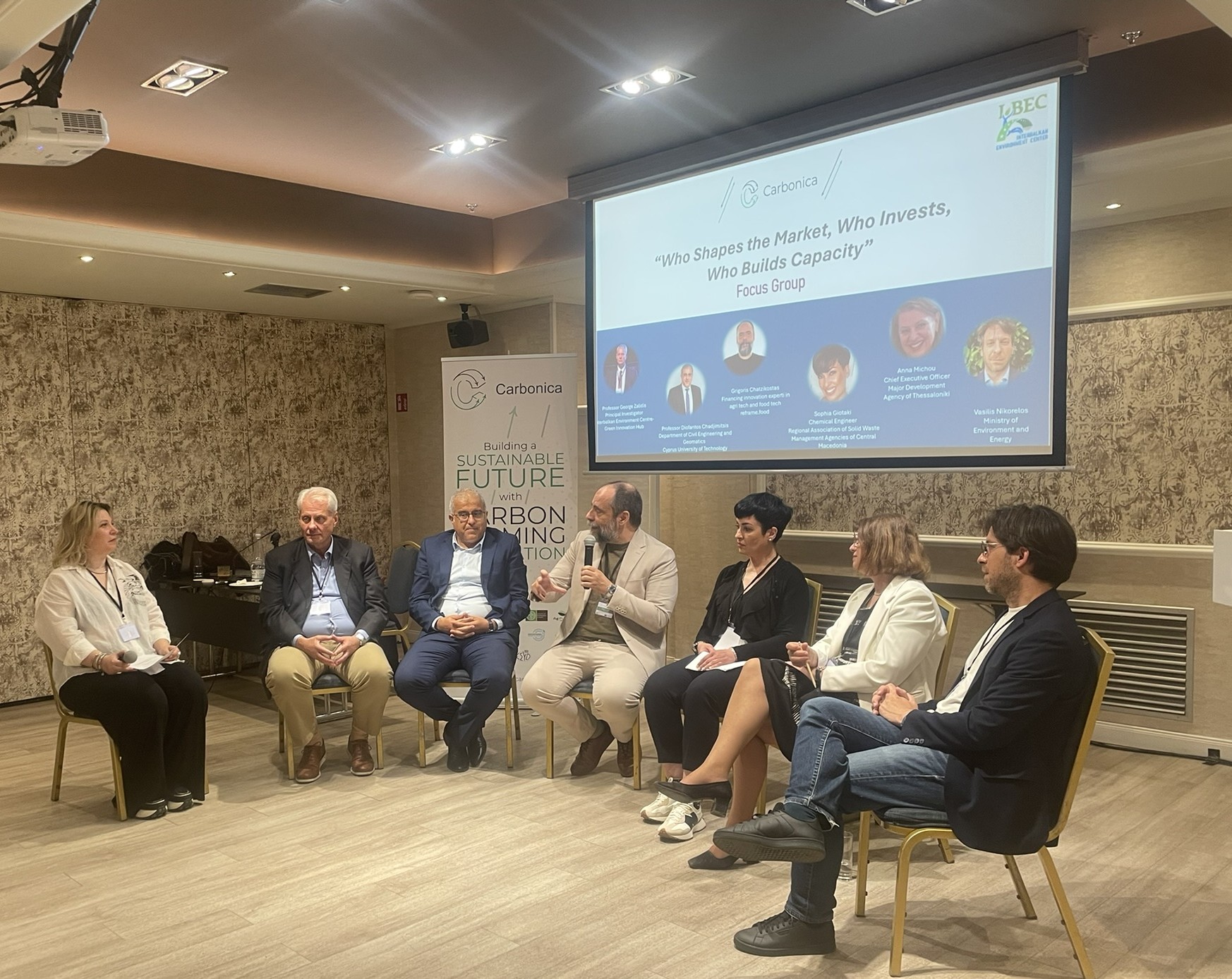
"Who Shapes the Market, Who Invests, Who Builds Capacity?"
Panelists:
Moderator: Dr Paraskevi Chantzi, Interbalkan Environment Centre (i-BEC)
Panelists:
Academia/Research: Prof. Diofantos Hadjimitsis | Cyprus University of Technology (Cyprus)
Academia/Research: Prof. Georgios Zalidis | Interbalkan Environment Centre (Greece)
Policy: Mr Vasilis Nikorelos | Ministry of Environment and Energy (Greece)
Accreditation: Mr Christos Trapalis | Hellenic Accreditation System (ESYD)
Industry: Mr Grigoris Chatzikostas | reframe.food (Greece)
Local Government: Mrs Anna Michou | Major Development Agency Thessaloniki (MDAT)
Public Sector: Mrs Sophia Giotaki | Regional Association of Solid Waste Management Agencies of Central Macedonia (FODSA)
Stakeholder Perspectives (Quadruple Helix):
Academia
Prof. Zalidis stressed the importance of national data infrastructures (satellite, soil, crop data and AI), linked with JRC and European dashboards, as the foundation of a functioning carbon economy. He argued that long-term financing and maintenance of these infrastructures are essential, together with demand-side market mechanisms that create buyers for carbon services. He also highlighted soil health as an increasingly valuable asset under forthcoming legislation and warned that poor coordination could lead to fragmented implementation.
Industry
Mr Chatzikostas highlighted a significant demand gap: although technologies are close to market readiness (high TRL), social readiness (SRL) and market readiness (MRL) remain limited, resulting in slow farmer adoption. He advocated for realistic implementation timelines, beginning with pilot projects before scaling up, and cautioned against repeating mistakes associated with the rapid implementation of previous Green Deal measures. Building trust and stimulating demand through buyer-side incentives were identified as critical priorities.
Academia
Prof. Hadjimitsis presented CARBONICA as a practical bridge between research, innovation and farmers through tools such as the Carbon Account platform, open satellite data and Living Labs. He emphasised that the main challenge is no longer technology but skills and adoption, highlighting the need for vocational training, professional certification and hands-on education. He also stressed the importance of local dissemination, accredited certifiers and start-up and spin-off opportunities to translate research into market-ready solutions.
Local Government
Mrs Michou presented development agencies as operational partners supporting municipalities by translating scientific knowledge into local strategies and projects. She highlighted data-driven policymaking, open environmental data, research on building resilience and municipal energy initiatives, while emphasising financing opportunities and citizen-oriented programmes.
Policy
Mr Nikorelos outlined the European policy drivers shaping the carbon economy and explained how forthcoming national legislation will translate these requirements into obligations for businesses and municipalities. He emphasised the need to establish a transparent carbon market framework, align regulation with financial institutions and ensure appropriate legal oversight to support a credible secondary carbon market.
Public Sector
Mrs Giotaki demonstrated how waste management can contribute to the carbon economy through separate waste collection, recycling, composting and biogas production. She presented current infrastructure developments and long-term recycling and landfill reduction targets, illustrating how regional waste management initiatives can become practical examples of circular economy implementation.
Key outcomes
- The carbon economy is emerging as a cross-cutting field where policy, markets, research, local government, technology and human capital converge. It should be treated not merely as a compliance regime but as a space for new services, investments, skills and partnerships.
- A shared vocabulary is required across stakeholders to enable clear communication and coordinated action.
- Reliable data, robust carbon monitoring, ESG systems and independent certification are essential prerequisites.
- Progress requires moving from knowledge to practice via pilots and living labs that demonstrate feasibility.
- New skills, defined professional roles, and accredited certifiers must be developed to support market growth.
- Market maturation depends on demonstrated demand and scalable examples that enable replication and investment.
- Local government and circular-economy initiatives are key practical arenas for applying carbon-economy measures.
💬 We invite forum members to share their views by responding to the pinned poll above. Your input helps enrich the discussion and reflect diverse perspectives from across the carbon farming community!
📸 Brain Gain Conference #6 Focus Group/ Discussion Panel speakers:
CARBONICA Brain Gain Conference #6
Title: “From Policy to Professions: Building the Carbon Economy Experts in Greece”
Date: May 12, 2026
Location: Macedonia Palace Hotel, Thessaloniki, Greece (hybrid event)
Lead Working Group: Cyprus
Moderators: Ms Daphne Kitsou & Dr Paraskevi Chantzi, Interbalkan Environment Centre (i-BEC), Greece
Working group speakers:
Prof. Georgios Zalidis, Principal Investigator and Scientific Coordinator, Interbalkan Environment Centre (i-BEC), Greece
Dr Paraskevi Chantzi | Scientific Coordinator, CARBONICA, i-BEC, Greece
Mr George Papapostolou | Project Manager, reframe.food, Greece
Invited diaspora expert speaker:
Mr Panagiotis Gkorezis, Agronomist & Managing Director, Brussels (Industry)
Panel Discussion:
"Who Shapes the Market, Who Invests, Who Builds Capacity?"
Panelists:
Moderator: Dr Paraskevi Chantzi, Interbalkan Environment Centre (i-BEC)
Panelists:
Academia/Research: Prof. Diofantos Hadjimitsis | Cyprus University of Technology (Cyprus)
Academia/Research: Prof. Georgios Zalidis | Interbalkan Environment Centre (Greece)
Policy: Mr Vasilis Nikorelos | Ministry of Environment and Energy (Greece)
Accreditation: Mr Christos Trapalis | Hellenic Accreditation System (ESYD)
Industry: Mr Grigoris Chatzikostas | reframe.food (Greece)
Local Government: Mrs Anna Michou | Major Development Agency Thessaloniki (MDAT)
Public Sector: Mrs Sophia Giotaki | Regional Association of Solid Waste Management Agencies of Central Macedonia (FODSA)
Stakeholder Perspectives (Quadruple Helix):
Academia
Prof. Zalidis stressed the importance of national data infrastructures (satellite, soil, crop data and AI), linked with JRC and European dashboards, as the foundation of a functioning carbon economy. He argued that long-term financing and maintenance of these infrastructures are essential, together with demand-side market mechanisms that create buyers for carbon services. He also highlighted soil health as an increasingly valuable asset under forthcoming legislation and warned that poor coordination could lead to fragmented implementation.
Industry
Mr Chatzikostas highlighted a significant demand gap: although technologies are close to market readiness (high TRL), social readiness (SRL) and market readiness (MRL) remain limited, resulting in slow farmer adoption. He advocated for realistic implementation timelines, beginning with pilot projects before scaling up, and cautioned against repeating mistakes associated with the rapid implementation of previous Green Deal measures. Building trust and stimulating demand through buyer-side incentives were identified as critical priorities.
Academia
Prof. Hadjimitsis presented CARBONICA as a practical bridge between research, innovation and farmers through tools such as the Carbon Account platform, open satellite data and Living Labs. He emphasised that the main challenge is no longer technology but skills and adoption, highlighting the need for vocational training, professional certification and hands-on education. He also stressed the importance of local dissemination, accredited certifiers and start-up and spin-off opportunities to translate research into market-ready solutions.
Local Government
Mrs Michou presented development agencies as operational partners supporting municipalities by translating scientific knowledge into local strategies and projects. She highlighted data-driven policymaking, open environmental data, research on building resilience and municipal energy initiatives, while emphasising financing opportunities and citizen-oriented programmes.
Policy
Mr Nikorelos outlined the European policy drivers shaping the carbon economy and explained how forthcoming national legislation will translate these requirements into obligations for businesses and municipalities. He emphasised the need to establish a transparent carbon market framework, align regulation with financial institutions and ensure appropriate legal oversight to support a credible secondary carbon market.
Public Sector
Mrs Giotaki demonstrated how waste management can contribute to the carbon economy through separate waste collection, recycling, composting and biogas production. She presented current infrastructure developments and long-term recycling and landfill reduction targets, illustrating how regional waste management initiatives can become practical examples of circular economy implementation.
Key outcomes
- The carbon economy is emerging as a cross-cutting field where policy, markets, research, local government, technology and human capital converge. It should be treated not merely as a compliance regime but as a space for new services, investments, skills and partnerships.
- A shared vocabulary is required across stakeholders to enable clear communication and coordinated action.
- Reliable data, robust carbon monitoring, ESG systems and independent certification are essential prerequisites.
- Progress requires moving from knowledge to practice via pilots and living labs that demonstrate feasibility.
- New skills, defined professional roles, and accredited certifiers must be developed to support market growth.
- Market maturation depends on demonstrated demand and scalable examples that enable replication and investment.
- Local government and circular-economy initiatives are key practical arenas for applying carbon-economy measures.
💬 We invite forum members to share their views by responding to the pinned poll above. Your input helps enrich the discussion and reflect diverse perspectives from across the carbon farming community!
📸 Brain Gain Conference #6 Focus Group/ Discussion Panel speakers:
 EN
EN  EL
EL  MK
MK 