
Establishing a forum dedicated to carbon farming Research and Innovation (R&I) within the CARBONICA platform represents a significant initiative to foster collaboration, knowledge sharing, and community building across various regions and expertise.
This forum is envisioned as an online space that gathers experts from all three Widening Countries (Cyprus, Greece, and North Macedonia) to pool their knowledge, experiences, and insights regarding carbon farming. It transcends geographical boundaries, encouraging participation from local experts and diaspora communities, fostering a diverse and global perspective on the subject.
At its core, this space is inclusive and inviting, welcoming project partners, stakeholders (such as farmers, researchers, policymakers, and environmentalists), and individuals enthusiastic about contributing to climate-resilient agriculture and carbon farming innovations.
CARBONICA Brain Gain Conference #5- From Diaspora Insights to Local Action: Advancing Carbon Farming for Resilient Agriculture in Cyprus

Παράθεση από eratosthenes-1 σε Μάιος 5, 2026, 6:49 πμTitle: “From Diaspora Insights to Local Action: Advancing Carbon Farming for Resilient Agriculture in Cyprus”
Date: April 28, 2026
Location: Aliathon Holiday Village, Paphos, Cyprus (hybrid event)
Lead Working Group: Cyprus
Moderator: Dr Christiana Papoutsa, Deputy Coordinator of the Environment & Climate Department, ERATOSTHENES Centre of Excellence (ECoE), Cyprus
Working group speaker: Dr Maria Prantsidou, Researcher, Eratosthenes Centre of Excellence (ECoE), Cyprus
Invited diaspora expert speaker: Dr Nikolaos Tsoulias, Senior researcher and lecturer, Hochschule Geisenheim University, Germany (Academia)
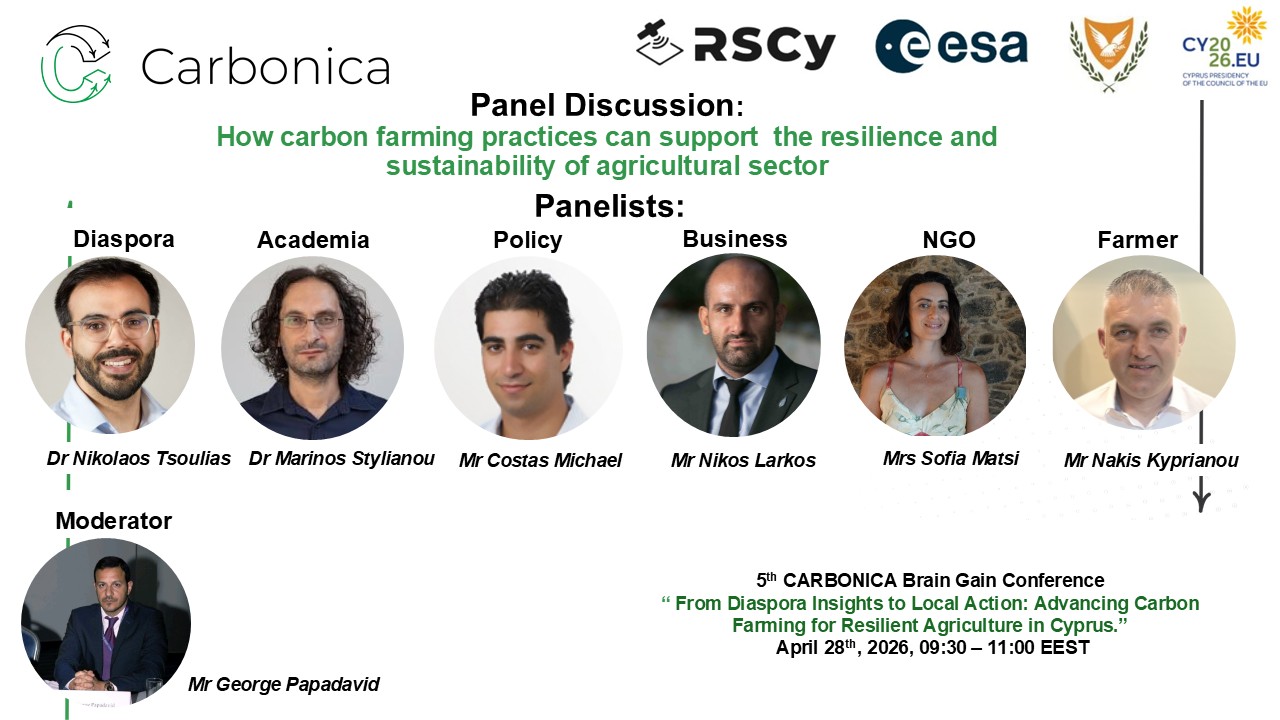
Panel Discussion:
“How can carbon farming practices support the resilience and sustainability of agricultural sector?”
Moderator: Dr George Papadavid, Officer, Agricultural Research Institute, Cyprus Ministry of
Agriculture, Rural Development and Environment, Cyprus
Panelists:
Diaspora Expert: Dr Nikolaos Tsoulias | Senior Researcher and Lecturer, Hochschule
Geisenheim University (GER)
Academia: Dr Marinos Stylianou | Assistant Professor, Faculty of Pure and Applied Sciences, Lab
of Chemical Engineering and Engineering Sustainability - Open University of Cyprus (CY)
Policy: Mr George Theophanous | Officer, Department of Agriculture - Cyprus Ministry of
Agriculture, Rural Development and Environment (CY)
Industry: Mr Nikos Larkos | Agronomist & Managing Director, AgroTech Innovations Ltd (CY)
Farming Sector: Mr Nakis Kyprianou | New Farmer, Agros Village (CY)
Civil Society/NGO: Mrs Sofia Matsi | Executive Director, Cyprus Environment Foundation (CY)
Overview:
The 5th CARBONICA Brain Gain Conference brought together stakeholders from academia, policy, industry, farming, and civil society to explore how carbon farming can support the resilience and sustainability of the agricultural sector in Cyprus. The session combined project insights from CARBONICA, a diaspora perspective on digital agriculture and carbon monitoring and a multi-actor panel discussion. The discussion highlighted the need to move from conceptual frameworks to practical, scalable, and economically viable solutions.
Stakeholder Perspectives (Quadruple Helix):
Civil Society / NGOs
Civil society from the perspective of a NGO, highlighted that farmer education is the foundation of the transition, emphasising the need for accessible tools and knowledge, regenerative practices, and certification schemes that add value to products.
Academia
Academia stressed the importance of co-creation and applied research, with living labs and demonstration sites bridging the gap between knowledge and practice, while acknowledging challenges such as delayed impacts and resource constraints.
Policy
Policy perspectives pointed to existing support through CAP schemes, but identified gaps in education, implementation, and farmer engagement, while also highlighting the importance of aligning incentives and strengthening consumer awareness to support transition in the long-term.
Industry / Agri-tech
Industry emphasised its role as a bridge between research and practice, highlighting the need for advisory systems, knowledge translation, and capacity building to support farmers in adopting innovation.
Farming Sector
Farmers identified finance and bureaucracy as the main barriers, stressing the need for simplified procedures, improved access to funding, and practical support to enable transition.
Diaspora Expertise
The diaspora perspective highlighted the complexity of measuring carbon in perennial systems, stressing that the key challenge lies in converting data into usable decision-making tools and improving traceability across the value chain to enhance the consumer awareness and support market development.
Key Conclusions:
- Education and capacity building are the foundation of the transition
All stakeholder groups emphasized that without knowledge, training, and advisory support, carbon farming cannot be effectively implemented.- Financial incentives are essential to drive adoption
Farmers are unlikely to adopt new practices without clear economic benefits, highlighting the importance of subsidies, eco-schemes, and future carbon markets.- Bridging the gap between research and practice is critical
Effective translation of innovation into practical solutions requires stronger advisory systems, co-creation approaches, and demonstration activities.- Carbon farming depends on functioning value chains
The transition is influenced by consumer behaviour. Without market recognition and willingness to pay for sustainable products, farmers lack incentives to adopt new practices. Consumer awareness and certification schemes are therefore essential to support adoption.- Digital technologies must deliver usable insights
The value of digital agriculture lies in turning complex data into practical decision-support tools, not simply in data collection.- Structural barriers must be addressed
Financial constraints, bureaucracy, and farm fragmentation remain key obstacles to implementation, particularly for young farmers.- Policy alignment and certification mechanisms are needed
Participants highlighted the need for better alignment of subsidies with sustainable practices, development of certification schemes (e.g. carbon or regenerative labels), policy frameworks adapted to local conditions
📎 A summary of the discussion outcomes is available as downloadable PDF.
💬 We invite forum members to share their views by responding to the pinned poll above. Your input helps enrich the discussion and reflect diverse perspectives from across the carbon farming community!
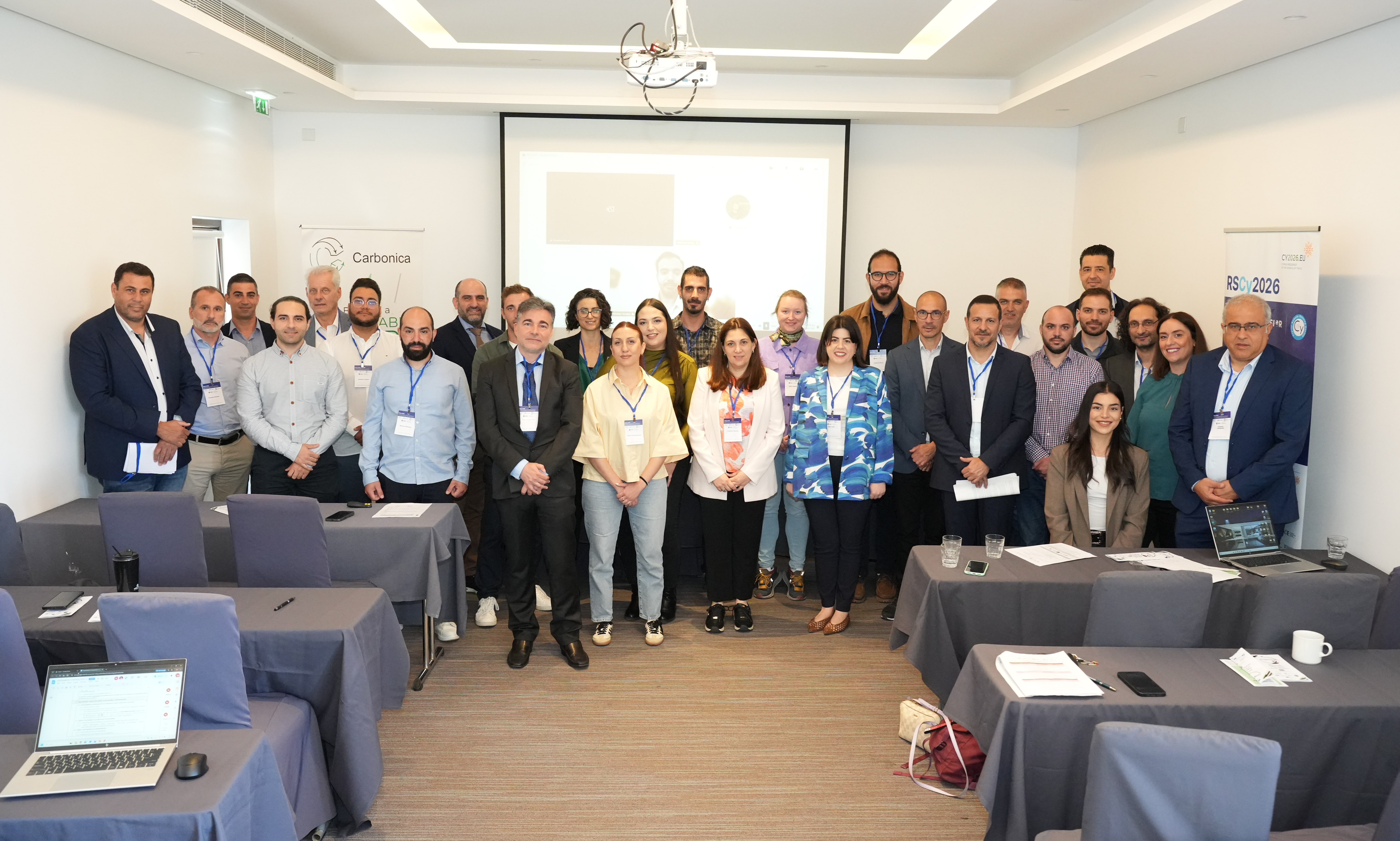
📸 Speakers and participants during the 5th CARBONICA Brain Gain Conference:
Title: “From Diaspora Insights to Local Action: Advancing Carbon Farming for Resilient Agriculture in Cyprus”
Date: April 28, 2026
Location: Aliathon Holiday Village, Paphos, Cyprus (hybrid event)
Lead Working Group: Cyprus
Moderator: Dr Christiana Papoutsa, Deputy Coordinator of the Environment & Climate Department, ERATOSTHENES Centre of Excellence (ECoE), Cyprus
Working group speaker: Dr Maria Prantsidou, Researcher, Eratosthenes Centre of Excellence (ECoE), Cyprus
Invited diaspora expert speaker: Dr Nikolaos Tsoulias, Senior researcher and lecturer, Hochschule Geisenheim University, Germany (Academia)
Panel Discussion:
“How can carbon farming practices support the resilience and sustainability of agricultural sector?”
Moderator: Dr George Papadavid, Officer, Agricultural Research Institute, Cyprus Ministry of
Agriculture, Rural Development and Environment, Cyprus
Panelists:
Diaspora Expert: Dr Nikolaos Tsoulias | Senior Researcher and Lecturer, Hochschule
Geisenheim University (GER)
Academia: Dr Marinos Stylianou | Assistant Professor, Faculty of Pure and Applied Sciences, Lab
of Chemical Engineering and Engineering Sustainability - Open University of Cyprus (CY)
Policy: Mr George Theophanous | Officer, Department of Agriculture - Cyprus Ministry of
Agriculture, Rural Development and Environment (CY)
Industry: Mr Nikos Larkos | Agronomist & Managing Director, AgroTech Innovations Ltd (CY)
Farming Sector: Mr Nakis Kyprianou | New Farmer, Agros Village (CY)
Civil Society/NGO: Mrs Sofia Matsi | Executive Director, Cyprus Environment Foundation (CY)
Overview:
The 5th CARBONICA Brain Gain Conference brought together stakeholders from academia, policy, industry, farming, and civil society to explore how carbon farming can support the resilience and sustainability of the agricultural sector in Cyprus. The session combined project insights from CARBONICA, a diaspora perspective on digital agriculture and carbon monitoring and a multi-actor panel discussion. The discussion highlighted the need to move from conceptual frameworks to practical, scalable, and economically viable solutions.
Stakeholder Perspectives (Quadruple Helix):
Civil Society / NGOs
Civil society from the perspective of a NGO, highlighted that farmer education is the foundation of the transition, emphasising the need for accessible tools and knowledge, regenerative practices, and certification schemes that add value to products.
Academia
Academia stressed the importance of co-creation and applied research, with living labs and demonstration sites bridging the gap between knowledge and practice, while acknowledging challenges such as delayed impacts and resource constraints.
Policy
Policy perspectives pointed to existing support through CAP schemes, but identified gaps in education, implementation, and farmer engagement, while also highlighting the importance of aligning incentives and strengthening consumer awareness to support transition in the long-term.
Industry / Agri-tech
Industry emphasised its role as a bridge between research and practice, highlighting the need for advisory systems, knowledge translation, and capacity building to support farmers in adopting innovation.
Farming Sector
Farmers identified finance and bureaucracy as the main barriers, stressing the need for simplified procedures, improved access to funding, and practical support to enable transition.
Diaspora Expertise
The diaspora perspective highlighted the complexity of measuring carbon in perennial systems, stressing that the key challenge lies in converting data into usable decision-making tools and improving traceability across the value chain to enhance the consumer awareness and support market development.
Key Conclusions:
- Education and capacity building are the foundation of the transition
All stakeholder groups emphasized that without knowledge, training, and advisory support, carbon farming cannot be effectively implemented. - Financial incentives are essential to drive adoption
Farmers are unlikely to adopt new practices without clear economic benefits, highlighting the importance of subsidies, eco-schemes, and future carbon markets. - Bridging the gap between research and practice is critical
Effective translation of innovation into practical solutions requires stronger advisory systems, co-creation approaches, and demonstration activities. - Carbon farming depends on functioning value chains
The transition is influenced by consumer behaviour. Without market recognition and willingness to pay for sustainable products, farmers lack incentives to adopt new practices. Consumer awareness and certification schemes are therefore essential to support adoption. - Digital technologies must deliver usable insights
The value of digital agriculture lies in turning complex data into practical decision-support tools, not simply in data collection. - Structural barriers must be addressed
Financial constraints, bureaucracy, and farm fragmentation remain key obstacles to implementation, particularly for young farmers. - Policy alignment and certification mechanisms are needed
Participants highlighted the need for better alignment of subsidies with sustainable practices, development of certification schemes (e.g. carbon or regenerative labels), policy frameworks adapted to local conditions
📎 A summary of the discussion outcomes is available as downloadable PDF.
💬 We invite forum members to share their views by responding to the pinned poll above. Your input helps enrich the discussion and reflect diverse perspectives from across the carbon farming community!
📸 Speakers and participants during the 5th CARBONICA Brain Gain Conference:
 EL
EL  EN
EN  MK
MK 